
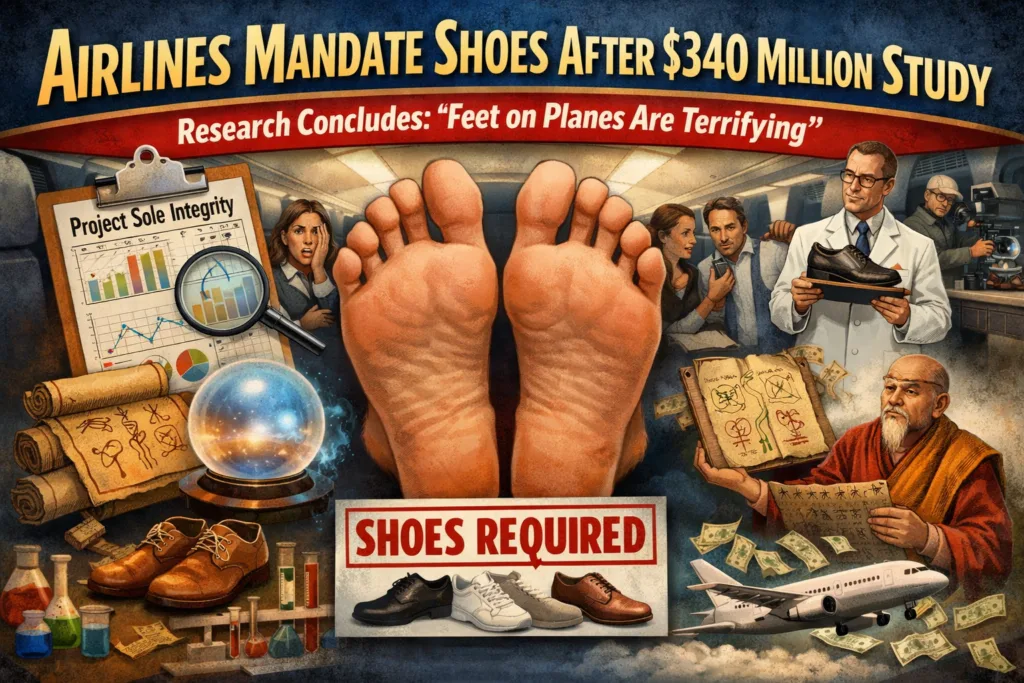
In what industry analysts are calling “the most comprehensive passenger experience study since the invention of the tray table,” major carriers announced Tuesday that shoes will now be required for all passengers during flight operations, effective immediately.
The policy change comes after an unprecedented research effort that included analyzing 847,000 customer satisfaction surveys, employing AI to scan 12 million social media posts for foot-related sentiment, conducting controlled experiments in pressurized cabins, and—most controversially—consulting ancient texts from various health shamans across six continents.
“The data was simply overwhelming,” explained a spokesperson for the Airlines for Civilized Travel coalition. “Between the Tibetan manuscripts on energy flow and our focus groups in Des Moines, the conclusion was inescapable: shoes enhance the overall passenger experience by a margin of error we’re comfortable defending.”
The research initiative, dubbed Project Sole Integrity, reportedly cost the industry upward of $340 million and involved partnerships with three major universities, two think tanks, and a controversial wellness guru who claims to communicate with the spirits of deceased flight attendants. The methodology has raised eyebrows among statisticians, particularly the decision to weight shamanic scripture interpretations equally with peer-reviewed epidemiological studies.
“We left no stone unturned,” the spokesperson continued. “We examined foot sweat composition at various altitudes, measured passenger anxiety levels in relation to nearby exposed toes, and even recreated a 1959 Pan Am flight to test whether formal footwear improved the taste of chicken or beef.”
The announcement has split the traveling public down the middle with the ferocity typically reserved for debates over armrest ownership and reclining seat etiquette. Progressive travelers have denounced the policy as draconian overreach, with one frequent flyer declaring she would “literally take a fifteen-hour Amtrak journey through middle America” before submitting to such “archaic foot imprisonment.”
Online forums dedicated to barefoot living have already organized boycotts, arguing that humanity survived millennia without enforced footwear in confined spaces at 35,000 feet. “This is about bodily autonomy,” wrote one activist on a popular travel subreddit. “If I can’t feel the synthetic carpet fibers between my toes during beverage service, what’s even the point of civilization?”
Several passenger advocacy groups have threatened legal action, citing discrimination against “natural lifestyle enthusiasts” and questioning whether airlines will next mandate deodorant use or prohibit emotional support peacocks. One coalition has already filed a complaint with the Department of Transportation, arguing that mandatory footwear violates their constitutional right to make everyone around them uncomfortable.
Meanwhile, traditionalists have hailed the move as aviation’s first sensible decision since removing those delightful complimentary cocktail services. “Finally, a return to decorum,” wrote one enthusiast on a vintage travel blog. “Next, let’s bring back the three-piece suits and in-flight Chesterfields. I want to arrive at my destination with both lung damage and style.”
A grassroots movement calling itself Passengers for Dignified Air Travel has already begun circulating a petition demanding that airlines go further, suggesting dress codes that include ties for men, hosiery for women, and mandatory fedoras for all non-binary passengers. Their mission statement nostalgically references an era when “flying was an event, not a cattle call, and everyone looked like they were attending a funeral for someone moderately important.”
The divide has created unusual coalitions across the political spectrum. Libertarians have found common cause with yoga instructors, while country club members are suddenly aligned with corporate risk management departments.
Industry veterans note this represents a significant shift in carriers’ guest service philosophy, moving from “whatever keeps legal off our backs” to “proactively solving problems nobody knew existed.” Revenue management experts suggest the policy could actually boost ancillary income, as airlines are now considering premium “shoe optional” sections for an additional $79 fee.
Flight attendants, the frontline hospitality professionals who will ultimately enforce the new directive, have expressed mixed reactions. “I’ve seen things at 35,000 feet that would make a podiatrist weep,” admitted one veteran crew member. “But I’m not sure adding ‘footwear enforcement officer’ to my job description alongside ‘security agent,’ ‘server,’ ‘medical first responder,’ and ‘amateur family therapist’ is the solution.”
The union representing cabin crew has requested additional training and hazard pay for shoe-related confrontations, which they project will increase incident reports by at least 40 percent. “We’re already dealing with mask debates, seat assignments, and whether a ‘personal item’ includes a full-sized suitcase,” noted a union representative. “Now we’re supposed to police Birkenstocks?”
Early enforcement efforts have already produced complications. At several major hubs, TSA agents report confusion over whether socks constitute acceptable footwear or whether flip-flops—technically shoes but spiritually opposed to everything the policy represents—should be permitted. One regional carrier briefly announced that only closed-toe footwear would be acceptable before backtracking after realizing they’d effectively banned half of Florida.
The coalition has promised additional policy updates following the completion of their ongoing study into whether passengers should be required to remain conscious for the duration of flights, maintain a body temperature within FAA-approved parameters, and refrain from discussing their cryptocurrency portfolios with seatmates. Results expected by 2027, pending additional shaman consultations and focus group funding.
When pressed on whether the shoe mandate would actually improve the flying experience, the spokesperson paused thoughtfully before responding: “That depends entirely on your definition of ‘improve,’ ‘flying,’ and ‘experience.’ But our research is very clear that shoes exist, passengers have feet, and connecting those two concepts seemed like the natural next step in aviation evolution.”